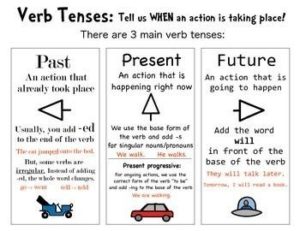
Friday, May 31, 2019

Simple Past Tense

But there are a lot of irregular past tense forms in English. Here are the most common irregular verbs in English, with their past tense forms:
Base formPast tense
be
begin
break
bring
buy
build
choose
come
cost
cut
do
draw
drive
eat
feel
find
get
give
go
have
hear
hold
keep
know
leave
lead
let
lie
lose
make
mean
meet
pay
put
run
say
sell
send
set
sit
speak
spend
stand
take
teach
tell
think
understand
wear
win
write
was/were
began
broke
brought
bought
built
chose
came
cost
cut
did
drew
drove
ate
felt
found
got
gave
went
had
heard
held
kept
knew
left
led
let
lay
lost
made
meant
met
paid
put
ran
said
sold
sent
set
sat
spoke
spent
stood
took
taught
told
thought
understood
wore
won
wrote
We use the past tense to talk about:
  • something that happened once in the past:
met my wife in 1983.
We went to Spain for our holidays.
They got home very late last night.
  • something that happened several times in the past:
When I was a boy, I walked a mile to school every day.
We swam a lot while we were on holiday.
They always enjoyed visiting their friends.
  • something that was true for some time in the past:
lived abroad for ten years.
He enjoyed being a student.
She played a lot of tennis when she was younger.
  • we often use expressions with ago with the past simple:
met my wife a long time ago.

Friday, May 24, 2019

Simple Present Tense

In English Grammar, the Present Tense is used to talk about something that is going on now(currently) or that is true now and at any time. Present Tense is of four types:
  • Simple Present Tense
  • Present Continuous Tense
  • Present Perfect Tense
  • Present Perfect Continuous Tense
Introduction to Tenses: Present Tense
(Source: pineterst)

Simple Present Tense

The simple present tense uses the same verb form as the root form of the verb. We use the simple present tense in the following conditions:
  • To show a fact or something that is always true
  • For activities that are done daily -regularly or habitually
  • To express thoughts, feelings, opinions and beliefs
  • For an action or event that is planned to happen in the future
  • Used with a selected few adverbs to indicate something that happens rarely
  • Used in news, reported speech such as in sports commentaries, a narration of books and stories etc
  • It is also used with schedules, plans and programmes
  • It is also used to give instructions

Friday, May 17, 2019

TYPES Of ANTONYM

You may be interested to know that there are three different kinds of antonyms. Let's take a look at each one:
Complementary: Complementary antonyms have no middle ground. Examples include:
  • boy - girl, off - on, night - day, entrance - exit, exterior - interior, true - false, dead - alive, push - pull, pass - fail
Relational: These are similar to complementary antonyms, except that both must exist for them to be antonyms of each other. Check out these examples:
  • above - below, doctor - patient, husband - wife, servant - master, borrow - lend, give - receive, predator - prey, buy - sell, instructor - pupil
Graded: These antonyms deal with levels of comparison and they can be two words on a scale. Many are relative terms, which can be interpreted differently by different people. Examples include:
  • young - elderly, hard - easy, happy - wistful, wise - foolish, fat - slim, warm - cool, early - late, fast - slow, dark - pale

Add a Prefix to Create an Antonym

Sometimes, you don't need to search for another word entirely. It's possible to create an antonym simply by adding a prefix to the word.
Some examples of antonyms created by adding the prefix dis- are:
  • Agree → disagree
  • Appear → disappear
  • Belief → disbelief
  • Honest → dishonest
Adding the prefix in- can make the following opposites:
  • Tolerant → intolerant
  • Decent → indecent
  • Discreet → indiscreet
  • Excusable → inexcusable
Using the prefix mis- create antonyms like:
  • Behave → misbehave
  • Interpret → misinterpret
  • Lead → mislead
  • Trust → mistrust
Examples of antonyms made by adding the prefix un- are:
  • Likely → unlikely
  • Able → unable
  • Fortunate → unfortunate
  • Forgiving → unforgiving
By adding the prefix non- you can make these antonyms:
  • Entity → nonentity
  • Conformist → nonconformist
  • Payment → nonpayment
  • Sense → nonsense

Simple Past Tense

But there are a lot of irregular past tense forms in English. Here are the most common irregular verbs in English, with their past tense fo...