Friday, May 31, 2019

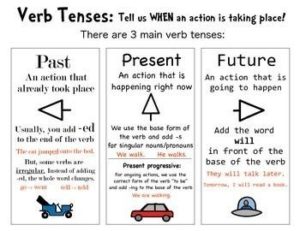
Simple Past Tense

But there are a lot of irregular past tense forms in English. Here are the most common irregular verbs in English, with their past tense forms:
Base formPast tense
be
begin
break
bring
buy
build
choose
come
cost
cut
do
draw
drive
eat
feel
find
get
give
go
have
hear
hold
keep
know
leave
lead
let
lie
lose
make
mean
meet
pay
put
run
say
sell
send
set
sit
speak
spend
stand
take
teach
tell
think
understand
wear
win
write
was/were
began
broke
brought
bought
built
chose
came
cost
cut
did
drew
drove
ate
felt
found
got
gave
went
had
heard
held
kept
knew
left
led
let
lay
lost
made
meant
met
paid
put
ran
said
sold
sent
set
sat
spoke
spent
stood
took
taught
told
thought
understood
wore
won
wrote
We use the past tense to talk about:
  • something that happened once in the past:
met my wife in 1983.
We went to Spain for our holidays.
They got home very late last night.
  • something that happened several times in the past:
When I was a boy, I walked a mile to school every day.
We swam a lot while we were on holiday.
They always enjoyed visiting their friends.
  • something that was true for some time in the past:
lived abroad for ten years.
He enjoyed being a student.
She played a lot of tennis when she was younger.
  • we often use expressions with ago with the past simple:
met my wife a long time ago.

Friday, May 24, 2019

Simple Present Tense

In English Grammar, the Present Tense is used to talk about something that is going on now(currently) or that is true now and at any time. Present Tense is of four types:
  • Simple Present Tense
  • Present Continuous Tense
  • Present Perfect Tense
  • Present Perfect Continuous Tense
Introduction to Tenses: Present Tense
(Source: pineterst)

Simple Present Tense

The simple present tense uses the same verb form as the root form of the verb. We use the simple present tense in the following conditions:
  • To show a fact or something that is always true
  • For activities that are done daily -regularly or habitually
  • To express thoughts, feelings, opinions and beliefs
  • For an action or event that is planned to happen in the future
  • Used with a selected few adverbs to indicate something that happens rarely
  • Used in news, reported speech such as in sports commentaries, a narration of books and stories etc
  • It is also used with schedules, plans and programmes
  • It is also used to give instructions

Friday, May 17, 2019

TYPES Of ANTONYM

You may be interested to know that there are three different kinds of antonyms. Let's take a look at each one:
Complementary: Complementary antonyms have no middle ground. Examples include:
  • boy - girl, off - on, night - day, entrance - exit, exterior - interior, true - false, dead - alive, push - pull, pass - fail
Relational: These are similar to complementary antonyms, except that both must exist for them to be antonyms of each other. Check out these examples:
  • above - below, doctor - patient, husband - wife, servant - master, borrow - lend, give - receive, predator - prey, buy - sell, instructor - pupil
Graded: These antonyms deal with levels of comparison and they can be two words on a scale. Many are relative terms, which can be interpreted differently by different people. Examples include:
  • young - elderly, hard - easy, happy - wistful, wise - foolish, fat - slim, warm - cool, early - late, fast - slow, dark - pale

Add a Prefix to Create an Antonym

Sometimes, you don't need to search for another word entirely. It's possible to create an antonym simply by adding a prefix to the word.
Some examples of antonyms created by adding the prefix dis- are:
  • Agree → disagree
  • Appear → disappear
  • Belief → disbelief
  • Honest → dishonest
Adding the prefix in- can make the following opposites:
  • Tolerant → intolerant
  • Decent → indecent
  • Discreet → indiscreet
  • Excusable → inexcusable
Using the prefix mis- create antonyms like:
  • Behave → misbehave
  • Interpret → misinterpret
  • Lead → mislead
  • Trust → mistrust
Examples of antonyms made by adding the prefix un- are:
  • Likely → unlikely
  • Able → unable
  • Fortunate → unfortunate
  • Forgiving → unforgiving
By adding the prefix non- you can make these antonyms:
  • Entity → nonentity
  • Conformist → nonconformist
  • Payment → nonpayment
  • Sense → nonsense

Friday, April 19, 2019

Say VS Tell

Meanings of Tell and Say
The meanings of these two verbs, telland say, are similar. The main meaning of tell is to "say or write something to someone." The main meaning of say is to "use your voice to express something in words." However, there are some clear and easy rules to follow about when to use these two words, as shown below.

Usage rules for Tell and Say 

Tell is used only to instruct or inform, and when the receiver of the information is included as an object of the verb. Do not use for quotes.
  • Has she told you the good news, yet?
  • Please tell us your name and occupation.
  • The police officer told him to stop. [NOT The police officer told him, "Stop."]
  • Can you tell me what happened?

Say is used for exact quotes, and when the receiver isn’t mentioned in the sentence:
  • “Good morning,” said the woman behind the counter.
  • I just stopped by to say hello.
  • said three words before he interrupted me again.

Say is also used to express opinions:
  • I wouldn't say that he's a great guitarist [=I don't think he's a great guitarist].
  • They say that you should drink eight glasses of water a day.

There are other uses of both of these verbs. For more information about sayand tell, follow the links below. 

Friday, April 12, 2019

Six types of task for TBL

In this article we look at different types of task, and see which kinds are most often used in textbooks. I also suggest ways of adjusting them so that they stimulate more opportunities for meaning-focused interaction, and encourage learners to give longer responses. Finally I show how a graded set of tasks can be developed on a theme.
Identifying task-like activities
In my first article Criteria for identifying tasks for TBL, we looked at six questions that gave us criteria to help us identify tasks and ‘upgrade' potential task-like activities into tasks. So now we can identify activities in a textbook unit that could become tasks and form the basis of a task cycle with;
  • Pre-task activities,
  • Task - Planning - Report cycle,
  • Post-task activities as illustrated in the activity Planning a class night out.
However, tasks tend to come in various disguises. Some textbooks contain quite a few task-like activities, but very few use the word ‘task’ to describe them. They often come under section headings like: Speak out! Listening challenge; Think … then compare ideas; Reach a decision; With a partner… In groups… It’s your turn… Questions and answers... Discuss ... Tell your partner… Writing… Reading or even under Grammar or Vocabulary…
For example, in ‘Total English’, a text-book for beginners, the activity: ‘Who is your favourite 20th Century icon? Tell your partner about the person.’ comes at the end of a Grammar section on ‘was / were’ which follows a reading activity.
There are several ways to turn this into a more rewarding task – as illustrated in Criteria for identifying tasks for TBLand you can also build up a graded set of tasks around this theme - as illustrated below.
Three types of task
Activities like the following generally have the potential to become effective tasks:
Listing and/or brainstorming
You can list people, places, things, actions, reasons, everyday problems, things to do in various circumstances etc.
Examples:
  • (1) In pairs, agree on a list of four or five people who were famous in the 20th century and give at least one reason for including each person; Can you remember your partner’s busiest day?
  • (2) On your own, make a list of all the things he/she did. Then check with your partner. Were there any things you forgot?
Ordering and sorting
This can be sequencing, ranking, or classifying.
Examples:
  • (3) In pairs, look at your list of famous people. Which people are most likely to remain popular and become 20th century icons? Rank them from most popular to least popular, and be prepared to justify your order to another pair.
  • (4) Look at the four pictures. They are mixed up. Work in pairs. Put the four pictures in a sequence so that they tell a story. Prepare to tell your story to another pair.
Matching
You can match captions / texts / recorded extracts to pictures; short notes or headlines to longer texts, e.g. news items.
Examples:
  • (5) Read the texts – each is about a famous person but the person is not named - and look at the photos. Match each text to a photo. Then talk to your partner, and say how you were able to match them. Prepare to tell the class how you did it.
  • (6) Read the four headlines A to D. Match two pieces of information (given in 1-8 below) to each headline. Explain to your partner how you did this. What clues did you find? Did you both use the same clues?
Do you have any tasks like these in your textbooks? Sometimes textbooks use Listing, Ordering and Matching activities at the beginnings of units, to introduce or revise useful words and phrases to prepare for the main topics. The outcomes are usually clear (e.g. a completed list, a set of matched information). But although they give valuable exposure to relevant topic-based language in the form of reading texts or recordings, they rarely stimulate much learner interaction as they stand.
Stimulating more interaction
All the examples I have given above are based on activities from real text books, but in each case I have added a further step or two to stimulate additional meaning-focused language use.
  • In 1 and 3 learners are asked to give reasons for or justify their decision
  • In 2, 5 and 6 they do the tasks individually then explain to their partner how they did them
  • In 3, 4 and 5 they are asked to prepare to explain how they did the task or tell their story to another pair or to the whole class.
Three more type tasks
Comparing: finding similarities and differences
Comparison tasks can be based on two quite similar texts or pictures (a classic example is ‘Spot the Differences’) or places or events etc that learners have experience of. Learners can also compare their own work with that of another learner or another pair or group.
Examples:
  • Compare your list of possible 20th century icons with your partner’s list. Did you have any people in common? Tell each other why you chose them. How many reasons did you both think of? Finally, combine your two lists, but keep it to five people.
  • Tell your picture story to another pair and listen to theirs. Compare stories – make a list of the main similarities and differences.
You will by now have noticed that many of these tasks carry on the same themes as in previous tasks. It is possible to build up ‘a set of tasks’ on the same theme, each one arising out of the previous one. This is an excellent way to build learner’s confidence – once they are familiar with the basic vocabulary for the topic, they can then do a range of activities recycling the topic language and using it for different purposes in a set of tasks.
Problem-solving
Text-books often contain activities based on common problems – pollution, relationships, noisy neighbours and so on. But sometimes problem-solving tasks are over too quickly – learners agree on the first solution that comes to mind, using minimal language, e.g. ‘Noisy neighbours? OK – so call police’. The instructions for the town centre traffic problem in the example below incorporate six or seven ways of generating richer interaction. Which of these ways might you use with your classes?
Example:
  • Think of a town centre where there is too much traffic. In twos, think of three alternative solutions to this problem. List the advantages and disadvantages of each alternative. Then decide which alternative would be the cheapest one, the most innovative one, the most environmentally friendly one. Report your decisions to another pair / group / the class, and discuss with them which solution would be the best one to put forward to the local government.
More complex tasks like comparing and problem solving sometimes involve processes found in simpler tasks, like listing – see previous examples. The task above – problem-solving - involves listing and quite a lot of comparing and evaluating.
Sharing personal experiences and story telling
Activities where learners are asked to recount their personal experiences and tell stories are valuable because they give learners a chance to speak for longer and in a more sustained way. And it is something we often do in real-life. However, as we saw from the ‘Grandparents’ activity in Criteria for identifying tasks for TBL, the instructions for activities where learners are encouraged to relate things from their personal lives are often rather vague and open-ended. In order to encourage richer interaction, we usually need to add a clear goal, make instructions more precise, and give clear completion points. See Criteria for identifying tasks for TBL which gives several ways to adjust activities like these.
Summary 
So far we have identified and commented on six types of task that sometimes appear in textbooks or that can be adapted from task-like activities. We have seen that a set of tasks can be built up around one topic. We have looked at ways of stimulating richer learner interaction and giving more opportunities for genuine meaning-focused language use and maximising learner responses.
Other activities like quizzes, questionnaires and projects can also generate rich interaction if set up in such a way as to maximise learner participation. Tasks can also be based on reading and listening texts. For three examples of task-based lessons such as these you can download see http://www.willis-elt.co.uk/taskbased.html
In my next article, I will show how we can exploit text-book material to help structure a task sequence, incorporating Pre-task activities, a task-cycle, leading on to language focus and form focused work.
References
The tasks in this article are based on activities from:
  • Face2face Pre-intermediate by Chris Redstone & Gillie Cunningham (Cambridge University Press 2005)
  • Total English Starter by Jonathan Bygrave (Pearson Longman 2007)
Further Reading
For more on task types, see Chapters 4 and 5 of Doing Task-based Teaching Dave Willis & Jane Willis (Oxford University Press 2006)
Written by Jane Willis, Consultant, Writer, UK

Friday, April 5, 2019

Different ways to say “I want”

We all know from school that “I want” can be a little too direct and impolite in some situations, and that “I’d like…” or “Could I have …” might be better.
As my mum used to tell us when we were kids: “‘I want’ never gets.”
She also used to say “hot burn hurt” to stop us touching hot kitchen stuff. I still kind of like that phrase.
Anyway — there are lots of different phrases for talking about what we want:

I could really do with …

This phrase is almost like “I need.”
It’s like saying “I know what could really fix this situation!”
So you could say things like:
“I could really do with a coffee right now.”
“We can’t get there in time just by walking. We could really do with a bike or something.”
We can also use it when we think something needs some work:
“Those trousers could really do with a wash! Weren’t they white before?”

I feel like …

When I was learning Turkish, I discovered the phrase “canım istiyor,” which can translate as “my soul wants it.”
That’s exactly what this phrase means — a spontaneous desire for something.
I feel like a nap.”
I feel like going to the beach today.”

I’m in the mood for …

This one is more light and fun.
You know those situations when you’re with lots of people, and you’re all trying to decide what to do this evening, and everyone has different ideas.
You could say something like:
I’m in the mood forbowling.”
You’re explaining what you want to do but without too much pressure.
So you can be in the mood for either a thing:
I’m in the mood for a sandwich.”
Or an action:
I’m in the mood fordancing.”

Friday, March 29, 2019

Say Thank You in English — Casual Situations

Did your friend just wish you and your husband a happy anniversary? Did your office celebrate your birthday with cake? Did a stranger hold a door open for you at the post office?
For these everyday, informal experiences, we can use a variety of expression to say thanks.
Thank you. / Thanks so much. / Thanks a lot. / Thanks a bunch. / Thanks!
Did your colleague at work just bring you a cup of coffee? Say:
  • “Thanks a bunch! I really need an extra dose of caffeine right now!”
  • “Thanks! You’re awesome for thinking of me.”
  • “Thank you!”

I really appreciate it. / You shouldn’t have.
Did your office just give you a birthday gift or a surprise party at work? Say:
  • “I can’t believe you did this! You shouldn’t have. But thank you so much. This was very kind of you.”
  • “What a thoughtful gift. I really appreciate this!”

I don’t know what to say! / That’s very kind.
A stranger on the street just gave you a compliment. Say:
  • “I don’t know what to say. Thank you.”
  • “That’s very kind of you. Thank you.”

You’re the best. / I owe you one. / You rock.
Your friend at work stayed late to help you finish a project.
  • “You’re the best. Thanks so much.”
  • “I really owe you one. I couldn’t have finished that project without. Next time you need help, I’ve got it.”

What would I do without you? / To say thank you is not enough. / I can’t thank you enough.
You had a stressful and difficult day at work. Your husband said he would take care of dinner and do all the cleanup. Say:
  • “What would I do without you? You’re wonderful.”
  • “I can’t thank you enough. I really need a night off.”

Simple Past Tense

But there are a lot of irregular past tense forms in English. Here are the most common irregular verbs in English, with their past tense fo...